Showing posts with label Jon Stewart. Show all posts

Monday, April 16, 2007

Can You Imagine Fifty People a Day...Friends, They May Think It's a Movement

To build upon some of my previous posts concerning what I feel is our society's lacklustre public dialogue (the ease with which we can dismiss a candidate for the smallest of bad PR, a general gleeful indignation with which we confront those that offend (clearly, this has a special significance with the recent Imus affair)). As I have been living in South Africa for the past two months, with only 3-4 channels to scan through on my tv (one of which plays cricket at all hours, an wholly unwatchable sport), my televised intake has grown increasingly focused and honed -- to the point that I basically watch clips from Comedy Central, MSNBC, and Real Time with Bill Maher, and dip the occasional finger into the Fox News gruel (Please, Sir, can I NOT have some more). This very limited and admittedly biased exposure to television, however, has afforded me the perspective that I needed to find some of these more deleterious trends in our national discourse.

On a fairly recent episode of the Daily Show, Jon Stewart interviewed Ambassador to the UN, John Bolton -- an extremely controversial figure and one of Bush's more antagonistic appointees. Bolton proposes his philosophy regarding presidential appointees, submitting that it is the duty of the president and his job to represent those (presumably solely those) who voted for him and appoint people who share his overall ideologies. Stewart returned with the example of Lincoln in reference to Lincoln's cabinet that was made up of a broad spectrum of political loyalists, many of whom disagreed with their President. So, with Stewart's more than reasonable historic example not even fully out of his mouth, Bolton quickly dismisses him, saying something to the effect of "I don't think you're right on the history there." The trend that this example...ahh, exemplifies is the envocation of historical citations, used either to dismiss the person you are debating or to silence the conversation. (Luckily, Jon has his own show and answered back the next night.)

In our current age, for those arguing on the rationally wanting side of a debate, a victory can achieved if you have managed to undermine your opponent's ability to prove their point, however honest and rational it may be (in fact, the more rational thier point the bigger your victory for not letting them make it). Do you, reader, remember the game "500"? One kid is the Thrower and shouts out a number (100, 200, 300, you get the idea) as he throws a ball into a small crowd of would-be catchers. If you were amongst this group and the ball is clearly out of your reach, your best bet is to somehow sabotage anyone elses chance of catching it. That's basically what this argumentative tactic is -- to use esoteric knowledge of history to silence you opponent or to dismiss someone else's knowledge out of hand is like pantsing the guy next to you so he won't catch the ball. A stretch? I think not.

So, here is my proposal. When someone tries to throw some irrelevant, yet oddly impressive factoid from American History your way, just smirk back and say, "Well, Tippecanoe and Fuck You, too!" And be sure to emphasis the last bit with all the gravitas of Lt. Col. Frank Slade. My theory, and I have not yet put it in practice, is that this will nullify any ground they have gained in the debate with their useless historical reference. I mean, what could they say back to that?You'll have beaten them at their own game. It's actually quite breathtaking. The rebuttle both alludes to an esoteric piece of American history (William Henry Harrison's 1840 campaign slogan) and also piques with a sort of ironic cruedity.

So, If you find yourself (in a dark alley and would like to press ahead, please turn to pg. 138) in a heated debate with Christopher Hitchens on Real Time with Bill Maher, or have inadvertently landed on a bar stool next to John Bolton and over a few too many rounds of shots enter into a political argument, don't let them garble the debate by trying to stun you with unecessary trivia. Just remember what we said, and they won't know what hit 'em.

Note: There is a definite distinction between admissible and warranted historic references for use in political discourse, this post only refers to those that are unecessary and used to spite or dismiss rather than enliven and edify.

Monday, February 26, 2007

Encyclopedic Knowledge Part II: You’re an Encyclopedia and You Didn’t Know It!


My previous post was really all I wanted to say about internet encyclopedias. I was supposed to get that off my chest and be able to wash my hands of the matter and get on with my day. I was looking forward to it. Then this happened.

If you are reading my post, you’ve probably read the CapeTownDissenter’s post which mentions the new Conservapedia, a Conservative Christian version of Wikipedia. Now, after having read about how much I hate the original (and utterly useless) Wikipedia, you can probably imagine my disgust when I learned that some lunatics made another one of these things. At first, there was no consoling me. No sooner had I (quite rightly and eloquently) pointed out how ridiculous it is that we even have Wikipedia in the first place (and I did so quite ingeniously, I might add), than the amount of Wikipedias in the world doubles! I mean I was pretty angry. First I considered putting my fist through a wall, but then I remembered that the walls in my apartment are load bearing walls, which means that it was going to hurt me more than it hurt the wall. Next I considered inviting the creators of both Wikipedia and Conservapedia to a cocktail party at my apartment where I would sit them down and, – like a high school football coach who yells at the team after screwing up a big game – after giving all of them the verbal tongue-lashing that they so desperately deserve, I would then stare silently at them for a few minutes, and finally try to give them a motivational speech about how to pick up the pieces of our previous, blissful Wikipedia-free world which they so carelessly smashed to…um, pieces, and try to start anew. Next I considered making pages on both Wikipedia and Conservapedia called “Useless Wastes of My and Your Time” and then explaining (quite systematically and compellingly) exactly why we should all be ashamed of ourselves that we even know that these things exist.

After a couple of deep breaths and one beautiful little ditty by Julieta Venegas (WBUR, you never fail to comfort me during my darkest and most troubled hours) I calmed down. I started to think about it a little bit. First there was Wikipedia, I thought. Well, no, I corrected myself (politely), first there was Google’s “I’m Feeling Lucky Button.” Then there was Wikipedia, a shameless rip-off of Google. And, thanks to the CapeTownDissenter who (unforgivably) broke the news to me the other day, now I know about Conservapedia. I was pretty incredulous as to the fact that not only is the original Wikipedia still in existence but that imitations are now springing up, so I went to the site just to see if I wasn’t having a terrifying nightmare (the test is that the internet never functions properly in a dream – it always takes too long to load and every link takes you to the same web site no matter what you are trying to access).

So I visit Conservapedia’s web site and it turns out that Conservapedia is the exact same freaking thing as Wikipedia except they recently started it from scratch whereas Wikipedia is about six years old and about a billion times bigger. I mean they didn’t even try to make it look different, or even change the name (they only changed half the name?! From “Wiki” to “Conserva”?!). Then I realized that Conservapedia means Conservative Wikipedia, which I guess is a Wikipedia for Conservative Christians who want to write these articles instead of whatever bozos are writing them for Wikipedia. Honestly I had no idea that Wikipedia was biased against Conservatives and against Christians (I thought it was just useless), but in any case we now have (an equally useless) one that takes an explicit effort to be biased in favor of these groups.

Now, unlike some of my co-dissentators, I don’t consider myself a member of either of America’s two main political parties, which I guess makes me a (hey voter voter voter voter) swing voter. To give you an idea of my moderateness, I often find myself farther to the right than many of my liberal friends, and I often find myself farther to the left than many of my…actually, wait…I’m not sure if I even have any conservative friends (they don’t call me the BostonDissenter just because I also happen to throw a glorious tea party). So, as a moderate open to all views (except those in favor of these ridiculous web sites existing), even I found this web site over the top. At first I was upset, I thought the “Anti-America bias” of Wikipedia claim was something of a stretch, and that maybe they should call the site “Psychopedia” (even a psycho would admit that name sounds better than Conservapedia (also conservapedia I believe is Spanish for “a whale’s vagina”)).

Then I realized something pretty amazing which totally turned me around on this Conservapedia. I did a little investigating and found out there was like nothing on it. Now, I realize it is just starting up, so this might not be true for much longer, but currently we are living in a golden age where – if we are willing to accept this thing as an encyclopedia – we know more than an encyclopedia. To give you an example of your encyclopedic knowledge, let’s start with a simple one. How about the country Spain. Conservapedia says:

“Country located on the Iberian Penninsula. Borderd by the Alantic Ocean to the west and the Mediterranean on the east. Portuagal is located on the same penninsuala. Is the same country as was in the medieval times. And known for its famous explorers.”

Now if you already knew all that, you have encyclopedic knowledge: the person searching should have just asked you! You maybe even know more! You maybe even know how to spell the words “peninsula,” “bordered,” “Atlantic,” and “Portugal!” Now I know this thing is supposed to favor America so things like countries, oceans, peninsulas and borders don’t really matter, but if we are supposed to be smarter than people from other countries, we should know more about their country than the know about America, which is hard to do post-Borat. So let’s try another country, Germany:

“A country in central Europe that was blamed for both Wolrd Wars and claimed to be the dominate race of mankind.”

Again, if you knew that too, you are as smart as an encyclopedia! And you probably would have called the “world” a “world” instead of a “wolrd!” I mean what is a wolrd anyway? I tried to look it up, but there wasn’t an entry for it. Then I looked up “world,” no entry for that either. Honestly I looked up “earth” and all the page said was “Mostly harmless.” Again if you know more than that about the earth you have encyclopedic knowledge. Now I know what you’re thinking: Conservapedia is pro-America so it really doesn’t matter whether there are articles about the wolrd or the world or whatever the hell that thing is that you were talking about. Well that’s why I looked up some American stuff as well. Now I know what else you’re thinking, you’re thinking what if you didn’t know as much as Conservapedia? For instance, what if you didn’t already know that Spain “is the same country as was in the medieval times”? Well don’t worry because to persuade you that you really are smarter than an encyclopedia, I have found a bunch of things that have no entry at all in Conservapedia, so if you have heard of even one, you have encyclopedic knowledge and you should start charging people to access your brain instead of those charlatans at Wikipedia and Conservapedia and whatever hell-spawned pedia’s that spring forth next. So those items are:

1. Alan Greenspan
2. Drudge Report
3. Rush Limbaugh
4. Argentina
5. David Brooks
6. John F. Kennedy
7. Supreme Court
8. Iraq
9. Mao Zedong
10. Taepodong
11. Ari Fleischer
12. CNN
13. Rolling Stones
14. Rice
15. Boston
16. Brain
17. Condoleeza Rice
18. Garth Brooks
19. Franklyn D. Roosevelt
20. London
21. World Bank
22. Wal-Mart
23. Jon Stewart
24. Harvard
25. Michael Jordan
26. New York Yankees
27. New York Times
28. Liberty University
29. Wall Street Journal
30. Education
31. Arnold Schwarzenegger

Incidentally, I don’t mean for this to be a contest between which of these two useless web sites is less horrendous, but I did find it noteworthy that while Conservapedia has no entry on the Taepodong, Wikipedia has three different Taepodongs in their encyclopedia.

In closing, I believe I’ve (quite nimbly) proven my point – that you are an encyclopedia and you didn’t know it. If for some reason you still haven’t heard of any of the above items, and you are still on equal footing, knowledge-wise, with Conservapedia, I will tell you something about Argentina. So to be smarter than Conservapedia (no one’s ever accused me of not making my readers smarter (than Conservapedia)), all you need to know about Argentina is that it gave us this.

Tuesday, February 20, 2007

Two Comedians, a Senator, and an Aging Institution

As a presidential candidate, Senator Obama, like Robert Kennedy before him, stands apart from the field of hopefuls by his easy and sincere ability to connect with young America. It only takes a moment to compare his campaign website, complete with social networking and a blog, to that of Senator Clinton or of Senator Edwards; Senator Obama mixes effortlessly with the Web 2.0 crowd, and more conspicuously, he seems equally at ease on the cover of fashion magazines (Men's Vogue) and the couches of our late night talk shows (Conan and The Daily Show). It is this natural ease that inspires both overblown praise and masked and bitter skepticism from the journalistic establishment (see Dowd below), as well as bewilderment, envy and careful praise from his fellow politicians.

Much in the same vein, the mainstream media display a similar uneasiness regarding Jon Stewart and Stephen Colbert. It’s getting hard to listen to NPR (for some of us, it has always been difficult) without hearing one of its many deadpan hosts invoke a quotation or clip from a recent Daily Show or Colbert Report. Whatever keeps “Fresh Air” fresh, I guess. Their forced and awkward (the type of awkwardness found only in the slew of movies depicting old white women dancing and/or rapping)deference toward Stewart and Colbert only betrays their total cluelessness for whatever it is that the kids are listening to these days. You know, they’re like totally clueless, dude, and so un-rad, man. Like whatever, Pops.


For simplicity’s sake and for that of my argument, let’s narrow the aging mainstream media and their frustration for their own ineptitudes to one journalist, Maureen Dowd of The New York Times. Dowd was given the recent cover story in Rolling Stone, featuring an interview with Stewart and Colbert. And it may just be that I was not picking up on her deft ironic tone or her comedic wit, but her opening lines are retarded:

"I thought Jon Stewart and Stephen Colbert might be a little nervous to meet with me. I was the real news commentator, after all, and they were the mock. They threw spitballs at presidents; I interviewed presidents before throwing spitballs at them. I had crisscrossed the globe to cover news stories, while these guys just put on dark suits and threw up imported backgrounds on a green screen."

Yeah, I guess, Maureen.

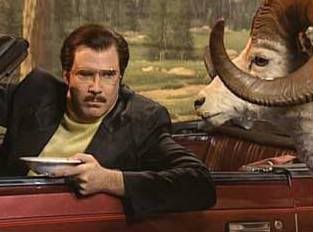
Again, if you, the reader, are trying to grasp the moment that you felt such a similar sense of uneasy embarrassment for another person, please see photo above. Dowd follows this with what is either a carefully thought out and philosophically taut opening question, a joke that falls painfully on its face, or just a bad question:

Dowd: A fake news show, "The Daily Show," spawned a fake commentator, Colbert, who makes his own fake reality defending the fake reality of a real president, and has government officials on who know the joke but are still willing to be mocked by someone fake. Your shows are like mirrors within mirrors, using a cycle of fakery to get to the truth. You've tapped into a sense in society that nothing, from reality shows to Bushworld, is real anymore. Do you guys ever get confused by your hall of mirrors?

Stewart: I didn't know we were going to have to be high to do this interview.

Her interview style, which seems ripped from the stuffy 1960’s journalists who used to ask Bob Dylan what his message is. She ranges from broad personal opinion, “Do you think the country would be better off if the Republicans or the Democrats were running it?”, to moments that reveal her deeper anxieties as a journalist: “Is there any way to bring young people, or all people, back to news?”. Dowd displays a similar approach to her Times column when, as she often does, she discusses Barack Obama – both condescending and awed at once – clearly fixated, but still able to bestow upon him such nicknames as “Obambi” and “Legally Blonde.” How cute! You really tapped into some happening pop culture puns there, Ms. Dowd. Maybe next time you could go with Ally McBama or wait, wait, wait…90210bama; that’ll sure grab the youth’s attention.

The walls are closing in for Dowd – the next two years she will be forced into writing about the Senator’s campaign while she and her colleagues pay increasing homage to Stewart and Colbert. In a moment that must have been both sheer terror and masochistic ecstasy for Dowd, these three figures that light the way to her oblivion are discussed at once during the Rolling Stone interview, when she asks, “But wouldn’t, say, a President Obama be harder to make fun of than these guys [the Bush administration]?” Luckily, we have Jon Stewart to return the question with the one I would like to ask her: “Are you kidding?”